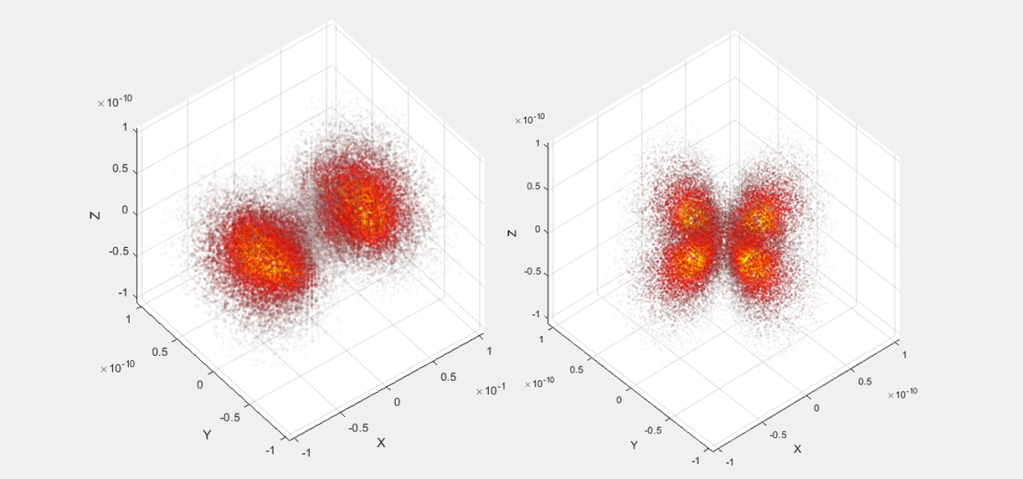
Quantum mechanics relies heavily on abstract mathematics—particularly the Time-Independent Schrödinger Equation (TISE)—to visualize electrons as probability clouds around atomic nuclei. But what if these clouds were more than mathematical abstractions? Could electron orbitals be explicit, stable wave structures formed by real, tangible wave interactions?
This investigation compares the familiar electron probability orbitals from quantum mechanics (s, p, d orbitals) directly with the wave-based model of Quantum Wavespace Theory (QWST). Surprisingly—or perhaps inevitably—these well-known shapes emerge naturally and intuitively from structured wave geometries. The implications? A physically meaningful reinterpretation of electron orbitals, potentially transforming our understanding of atomic structures and nuclear fusion.
Explore how clearly QWST matches—and perhaps even illuminates—the puzzling quantum world:
 Quantum Wavespace Theory
Leave a comment