The Universe as a Single Constrained Energy Structure
Quantum Wavespace Theory (QWST) models the universe as one finite, persistent energy structure constrained by a maximum propagation speed C, a maximum local energy-storage density P0, conservation of its total energy E0, and the requirement of stable equilibrium.
The fundamental question is what physical structure follows when energy cannot be stored without limit, cannot propagate without limit, and must nevertheless persist as a conserved system.
What If Matter Inherits Its Quantum Properties from Quantum Wavespace?
Conventional physics generally treats spacetime geometry and quantum fields as distinct foundational ingredients. Matter arises from excitations of those fields; spacetime provides the geometry in which they exist.
Quantum Wavespace Theory asks whether that separation is fundamental at all.
Quantum Wavespace is not an empty container for matter, and it is not an additional mechanical medium placed underneath it. It is the proposed coherent energy structure itself — carrying physical constraints such as the propagation limit C, the storage limit P0, a characteristic scale r0, and the allowed geometries and frequencies of its stable modes.
Protons, electrons, photons and other physical phenomena are therefore not separate objects inserted into Quantum Wavespace. They are localized, circulating or propagating configurations of that structure.
In that sense, the physics is moved from the object into the structure that makes the object possible.
A Maximum Local Energy Density Changes the Problem
The proposed limit P0 is more than another constant. It is an organizing constraint. Once local storage reaches saturation, additional energy cannot simply continue piling into the same region.
The excess must reorganize. It can move, circulate, propagate, or become part of a larger coherent configuration. Storage and transport are therefore not separate physical processes appended to the theory; they are complementary behaviors forced by the same constraints.
Waves Are the Working Model, Not the Fundamental Assumption
The name “Quantum Wavespace Theory” reflects the mathematical model used to develop the framework, but QWST does not require nature to be literally composed of sine or cosine waves.
Standing waves are particularly useful because they naturally describe repeated exchange between storage and transport. But fields, tensors, strings, solitons, probability amplitudes or another mathematical representation could also be used if they reproduce the same underlying physical constraints and observable consequences.
Two Primitive Geometries Organize the Wave Model
When the constrained structure is represented as a wave system, two especially simple geometric families emerge.
Spherical standing modes
Localized energy can focus isotropically into a spherical configuration. A saturated spherical mode provides the working QWST model of nucleon storage.
Cylindrical and toroidal circulation
Energy that cannot remain locally stored can redistribute axially or circulate around a closed path. Cylindrical and toroidal modes provide the working geometry for transport.
Once these two primitive geometries exist, three basic classes of interaction follow naturally: sphere–sphere, cylinder–cylinder, and sphere–cylinder coupling.
How Does Stored Energy Choose a Size?
A saturated storage region cannot simply expand without cost. Increasing its radius increases the volume that must remain coherently organized at the limiting storage density while preserving transport and phase closure.
In the present QWST wave realization, stationary action provides the mathematical route to a finite equilibrium storage scale r0.
The same construction gives the quantum of action in a physically suggestive form:
In this expression, action is the product of an energy-flux scale, an effective storage volume and a transport length. Planck’s constant is therefore interpreted not as an arbitrary quantum rule, but as the characteristic action associated with one complete storage–transport geometry.
Saturation Provides an Organizing Principle for Matter
Once the storage mode reaches P0, additional coherent energy requires another degree of freedom. Circulation provides one natural solution: energy can be redirected without demanding still greater local compression.
This creates a simple physical sequence: localized storage reaches saturation; transport modes develop; energy circulates or propagates; returning energy maintains the stored structure.
In this picture, stable particles and transient interactions are not fundamentally different substances. They are different organizations of the same storage and transport behaviors.
Atomic Spectra Reveal Two Different Coupling Scales
The familiar fine-structure constant α appears in QWST as a coupling or sampling factor between the spherical nucleon structure and the cylindrical electron mode.
A second quantity is required to describe how strongly the underlying storage structure itself resists displacement from equilibrium. QWST denotes this restoring response by gR.
The measured Rydberg constant provides an indirect probe of this restoring response. In the present QWST relation,
Once r0 is specified, atomic spectroscopy therefore constrains the magnitude of gR. The atomic energy levels are not a measurement of gR alone; they contain the combined effects of restoring response, geometry and electron coupling.
One Restoring Response Can Appear as Deflection, Binding or Attraction
A persistent energy configuration must react when disturbed. The direction and observable form of that reaction depend on the geometry of the disturbance.
During close approach, two saturated storage structures can resist overlap and deflect one another. Under the right conditions they may reorganize into a coupled configuration, producing binding or fusion. At much larger scale, a small global imbalance can instead produce a net attractive response.
From the Nucleon Scale to a Finite Global Structure
QWST applies the same physical constraints to the universe as a whole. The finite conserved energy E0 does not occupy an unconstrained infinite background; it forms an evolving finite structure with an outer extent R(t).
Reflection, return and leakage allow that structure to evolve toward a persistent global equilibrium radius R0.
In the wave realization, the same microscopic scale r0 that organizes localized storage also establishes the fundamental wavelength and node spacing of the larger eigensystem. Nuclear, atomic and cosmological behavior are therefore not isolated sectors of the model.
The Hubble Tension Becomes a Time-History Test
If the global structure approaches R0 through ring-down and boundary leakage, then the universe observed at an earlier epoch need not have exactly the same effective state as the universe measured locally today.
QWST therefore does not automatically interpret differing early- and late-universe expansion measurements as an anomaly. A systematic difference is expected in principle if the underlying global structure continues to evolve.
A Stable Wavespace Requires Return — and Permits Leakage
A persistent global standing structure requires returning coherent energy. Perfect return, however, would describe an ideal closed cavity with no relaxation. QWST instead uses a weakly leaky outer boundary.
Most of the coherent outward structure participates in the return that maintains the cavity. A very small non-returning component allows ring-down and leaves a persistent imbalance.
QWST associates the restoring reaction to this imbalance with gravity. The current one-way gravitational deficit is
Gravity and Dark Energy Point to the Same Tiny Boundary Scale
An independent dimensionless quantity can be constructed from the observed dark-energy density by expressing it relative to P0.
| Independent scale | Value |
|---|---|
| Gravity / boundary deficit | 2.6 × 10−45 |
| Observed dark-energy scale | 3.3 × 10−45 |
These quantities are of the same order and differ by approximately 27%. QWST does not require an exact numerical identity.
The QWST Proposition in Five Moves
The Important Test Is Not Another Numerical Coincidence
QWST becomes scientifically significant only if the same constrained structure continues to generate successful results without introducing a new mechanism for every phenomenon.
A Framework to Test, Not a Finished Theory to Accept
Quantum mechanics, quantum field theory and general relativity remain extraordinarily successful empirical descriptions. QWST does not gain credibility by ignoring those successes; it must recover them where they apply and explain why their characteristic constants and structures arise.
Some QWST relationships are mathematically developed. Some currently use measured quantities as calibrations. Other proposed connections, including detailed fusion dynamics, the global boundary evolution and the origin of the CMB photon spectrum, remain open calculations.
Where each result currently stands
Some QWST relations follow from the geometry alone, some use a measured quantity as a calibration, and some are still open calculations. This table separates them so each claim can be judged on its own terms.
| Quantity or relation | Status | What enters and how it compares |
|---|---|---|
| Fine-structure constant, α−1 = B0β0 | Derived from geometry | Bethe-aperture overlap and return factor. Gives 137.03614 against CODATA 137.03600, about 1 ppm. Higher-order return terms are still to be evaluated. |
| Electron magnetic anomaly | Derived from geometry, using measured α | Single Bessel return with the cavity transmission formula. Agrees with CODATA to about 0.02 ppm, with α taken as a measured input. |
| Storage profile integral A0 ≈ 1.020 | Derived from geometry | Computed from the pressure-limited cosine profile of the spherical storage mode. |
| Nucleon equilibrium radius r0 | Closure from inputs | From h, C, P0 and A0: about 0.66 fm. Compares with the ~0.6 fm pressure sign change reported by Burkert, Elouadrhiri and Girod (2018). |
| Global boundary radius R0 | Closure from inputs | Obtained from the gravitational relation using measured G. Gives 1.29 × 1026 m against a Hubble distance of about 1.30 × 1026 m. |
| Storage limit P0 ≈ 5 × 1035 Pa | Empirical scale | Order of magnitude proposed by H. W. Schmitz in the 1970s and consistent with the 2018 proton pressure extraction. Not yet derived from first principles. |
| Restoring gain gR (written gΣ in the papers) ≈ 978.67 | Calibrated | Fixed once from the Rydberg constant through R∞ = 1/(144 gR2 r0). The energy-bridge and mass-ratio paths then return the same value. |
| Planck constant, h = 2 mn r0 C | Consistency relation | Agrees by construction, because h is used as an input to the r0 closure. Its value lies in the physical interpretation, not as an independent prediction. |
| Higher-order α and coherence correction ℓ ≈ 0.976 | Open calculation | Requires numerical evaluation of three-dimensional Bessel overlap integrals at the aperture boundary. |
| Global evolution R(t) and the Hubble tension | Open calculation | R(t) must be derived from ring-down and leakage and then match the observed redshift dependence without separate fitting. |
| Gravity and dark-energy scales, εG and εΛ | Open calculation | Same order (2.6 and 3.3 × 10−45), differing by about 27%. A common derivation from boundary leakage is not yet complete. |
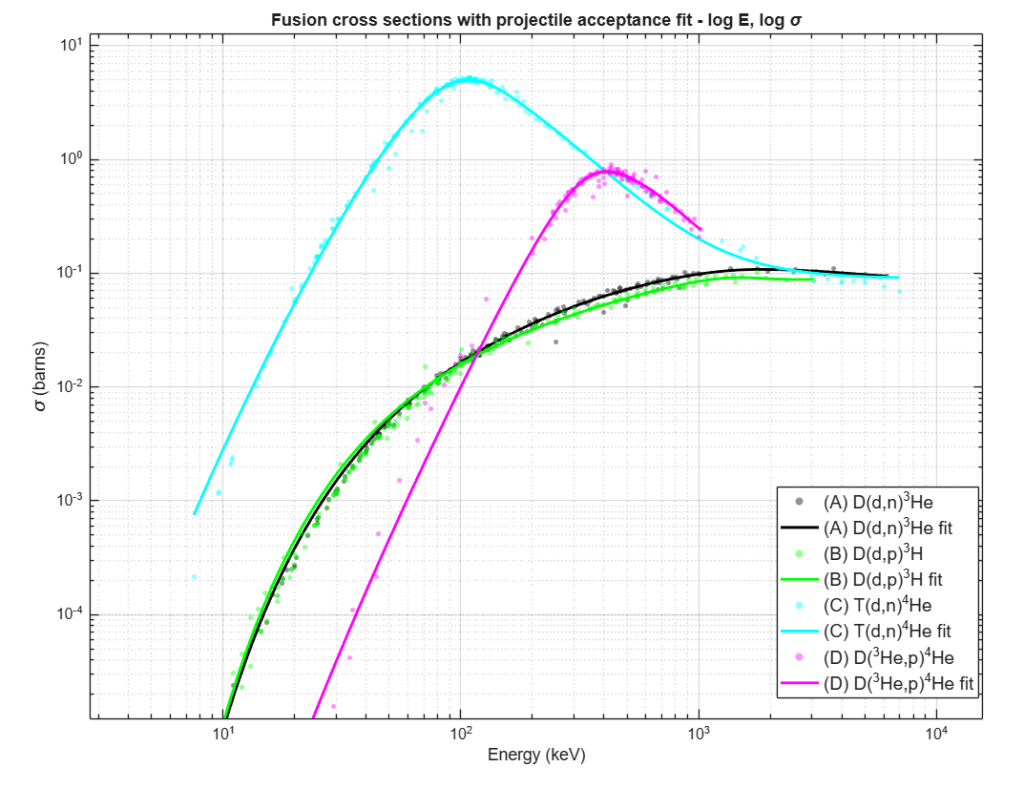
| Fusion cross-sections | Open calculation | Current curves use a fitted projectile-acceptance model and are consistent with EXFOR data. A dynamical derivation from the restoring law is still to come. |
| CMB photon spectrum | Open calculation | The origin of the spectrum within the global structure has not yet been worked out. |
| P0 and r0 from first principles | Open calculation | Removing the dependence on measured h and the empirical pressure scale is the central remaining step for the foundation. |
Full derivations and residuals are in the Foundations document. Corrections and independent checks are welcome.
Earlier overview, retained as published
The material below was the main presentation of Quantum Wavespace Theory before the September 2026 update. It is kept unchanged because it accompanies preprints on Zenodo whose dates form part of the project’s record.
Where the two differ, the overview above and the latest Foundations document take precedence. This applies in particular to the wording about adjustable parameters, which quantities are calibrated, and the precision of derived constants. The earlier text uses gΣ for the restoring gain written gR above; they are the same quantity.
A Simplified Physical Foundation
Quantum Wavespace Theory (QWST) starts with a simple question: what happens if wave energy has a maximum density it can sustain?
We know there’s a maximum speed — C. Physics is built on it. QWST adds one more limit: a maximum local energy density P₀. With both limits in place, the medium has no choice. Energy that exceeds local storage must redirect into propagation. Energy that exceeds propagation must concentrate into local storage. The cycle is forced, not postulated. What we call wave behavior is simply what a doubly-limited medium has to do.
This is the piece that was missing from earlier wave theories. In the early twentieth century, physicists tried to build matter from waves and could not make it work — linear waves don’t stay put, and amplitudes ran without bound. They abandoned the wave picture and moved to point particles and probability. QWST says they were right to give up on linear waves, but wrong to give up on waves entirely. Add a saturation limit and the waves confine themselves.
From these two limits — C and P₀ — stable structures form at a definite local radius r₀ and a definite global radius R₀. Inside this cavity, only two geometries persist: spherical storage modes (nucleons) and cylindrical/toroidal transport modes (electrons, photons, quarks, neutrinos). Their three coupling channels — sphere–sphere, sphere–cylinder, and cylinder–cylinder — produce the constants of nuclear physics, atomic physics, electromagnetism, and gravitation. Newton’s (G), the fine-structure constant, the Hubble distance, and the CMB temperature are treated as consequences of closure relations built from the same two limits: finite storage (P_0) and finite transport (C). The magnitude of (P_0) is then checked against the proton pressure scale inferred from experiment, rather than introduced as a curve-fit parameter. Cross-scale couplings, such as (g_\Sigma), are fixed by atomic-scale closure relations and developed in the reference manuscript. They are not additional postulates.
QWST does not replace the Dirac equation, quantum electrodynamics, or general relativity. It provides a geometric foundation from which they emerge.
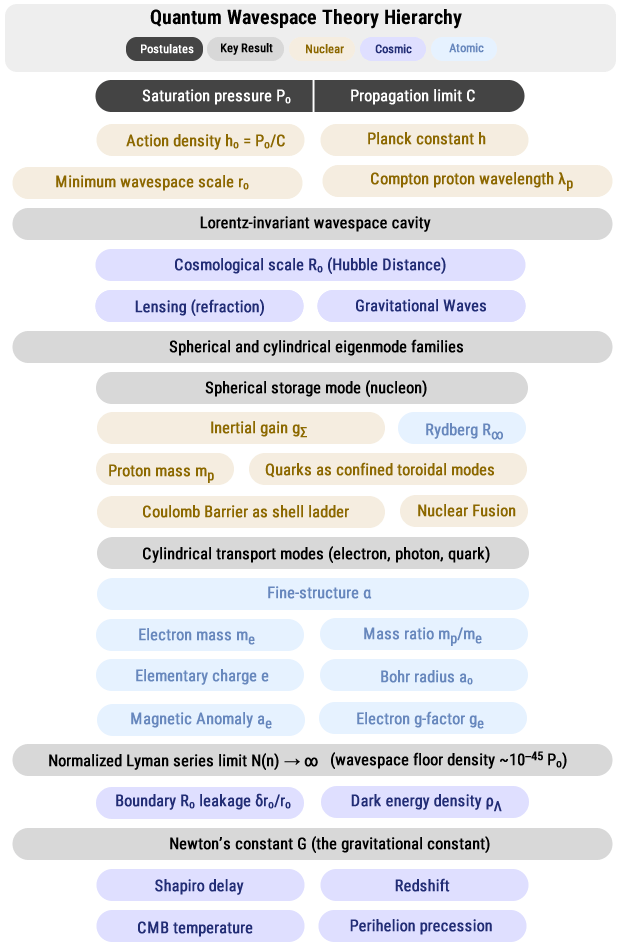
The QWST framework at a glance.
From two postulates — the saturation pressure and the propagation limit — the framework derives the fundamental constants of nature across nuclear, atomic, gravitational, and cosmological domains. The gray bars indicate structural milestones, with blue, violet and brown bubbles indicating domain-specific results.
The QWST framework contains no adjustable parameters: every quantity listed below the two postulates and is derived using wave mechanics and geometric integrals.
What is new about this framework
The wave picture of matter has been pursued before. Louis de Broglie proposed matter waves in 1924 and won the Nobel Prize for it. David Bohm developed the pilot wave in the 1950s. Erik Verlinde proposed emergent gravity in 2011, recovering Newton’s law from holographic information. John Bush at MIT has demonstrated walking droplets at the tabletop — millimeter-scale oil droplets that self-propel through their own wave fields, exhibiting quantized orbits, tunneling, and diffraction. Each of these programs is real, well-cited, and ongoing.
What QWST contributes is a specific synthesis of three ingredients that none of the antecedent programs combined.
The storage limit P₀ as a fundamental postulate. This is what saves the wave picture from the unbounded-amplitude failure that drove physics to abandon it a century ago. Neither de Broglie nor Bohm nor any other wave-substrate proposal added a saturation limit. The combination of C and P₀, not C alone, is what allows stable particles to exist as standing waves.
The restriction of stable structures to exactly two geometric mode families. Spheres store; cylinders (with their toroidal closures) transport. Everything else is unstable. This is a strong predictive constraint that reduces the parameter space of the framework dramatically. Most wave-substrate theories are either underdetermined (any field configuration is allowed) or overdetermined (specific dynamics for specific fields, with little geometric constraint). The two-mode restriction is unique to QWST.
An explicit coupling between the local scale of the nucleon and the global scale of the cosmos. The two scales are not separate problems. They are coupled through a single number — g_Σ — which simultaneously fixes the hydrogen mass ratio and Newton’s gravitational constant. This is what allows atomic and gravitational physics to emerge from the same framework. Sciama attempted something Machian in 1953 but did not carry it through quantitatively. Verlinde works cross-scale through holography but does not get atomic structure from it. The QWST claim — one number, fixed once, governs both an atomic constant and a gravitational constant — has no direct parallel in the prior literature.
Each ingredient individually has precedent. The combination is what makes the constants of nature computable.
The framework was originated by Harry W. Schmitz in the 1970s and developed across multiple documents in the decades since. Its central quantitative prediction — that the proton’s internal pressure should be of order 10³⁵ Pa — was later found to be consistent with the proton pressure distribution extracted by Burkert, Elouadrhiri, and Girod from deeply virtual Compton scattering data.
2026 Revision Announcement
The Quantum Wavespace Project announces a major revision for 2026. The foundational document has been substantially expanded and restructured, incorporating new results on the cylindrical eigenmode structure of the electron, the geometric origin of spin-½ from the Pauli algebra of coupled cavity modes, a unified treatment of the fine-structure constant and electron magnetic anomaly from a single Bessel aperture geometry, and the identification of the electron’s rest mass with a thin-wall cavity structure. The revised framework spans nuclear, atomic, gravitational, and cosmological domains from two constraints, with quantitative agreement across more than seventy orders of magnitude in scale.
The current foundational reference is available below, and will be updated periodically with additional material based on the framework. Companion analyses — including applications to nuclear fusion cross-sections, neutrino mass structure, and photonic systems — are developed in separate documents within the project.
Latest PDF as of June 22nd, 2026
The latest publications are available here: https://zenodo.org/communities/qwst/
Figures
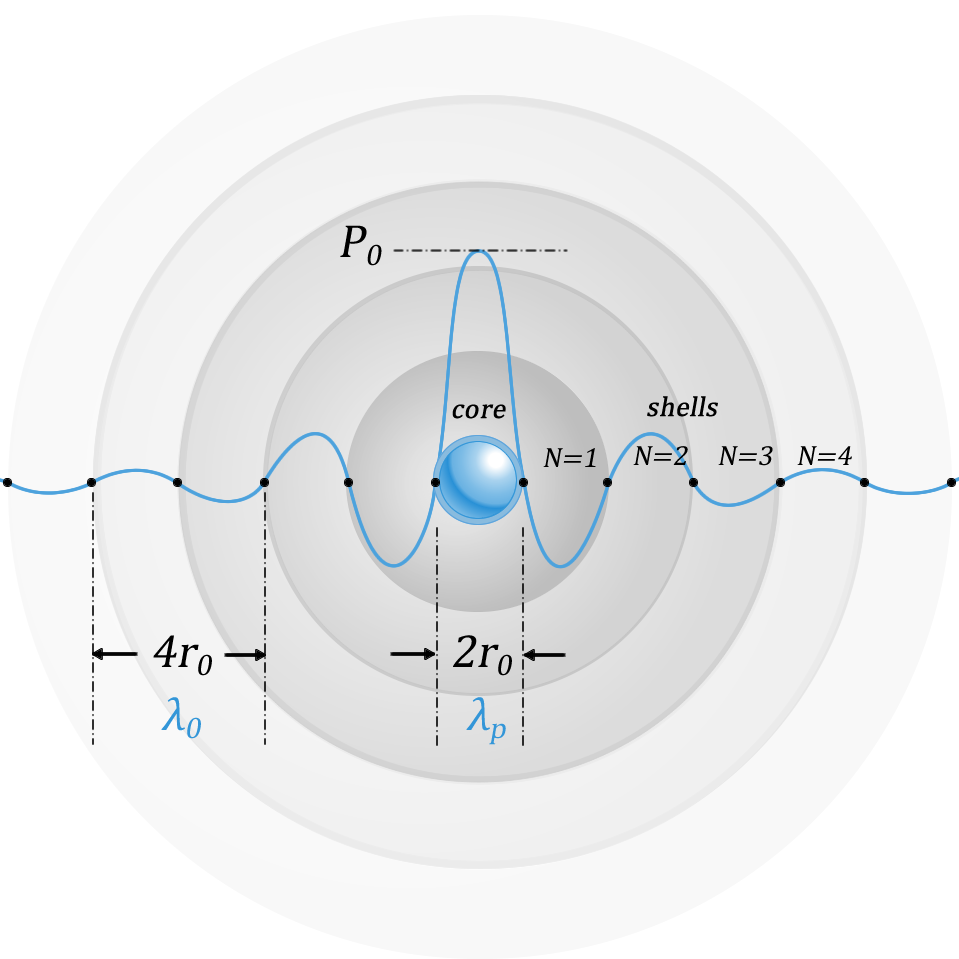
The nucleon as a spherical standing wave. The nucleon is not a point particle but a standing wave with a central pressure peak at the storage limit P₀, falling to a first node at the local boundary radius r₀. Beyond the core, the field oscillates outward through concentric shells of alternating sign (N=1, 2, 3, 4 in the figure) with energy density falling as 1/N². The core diameter 2r₀ defines the proton’s Compton wavelength λ_p; the shells are spaced at λ₀ = 4r₀ node to node. This is the canonical spherical storage mode of QWST — energy stored isotropically, bounded by P₀, confined at r₀.
[Figure 1 — 1D nucleon profile]
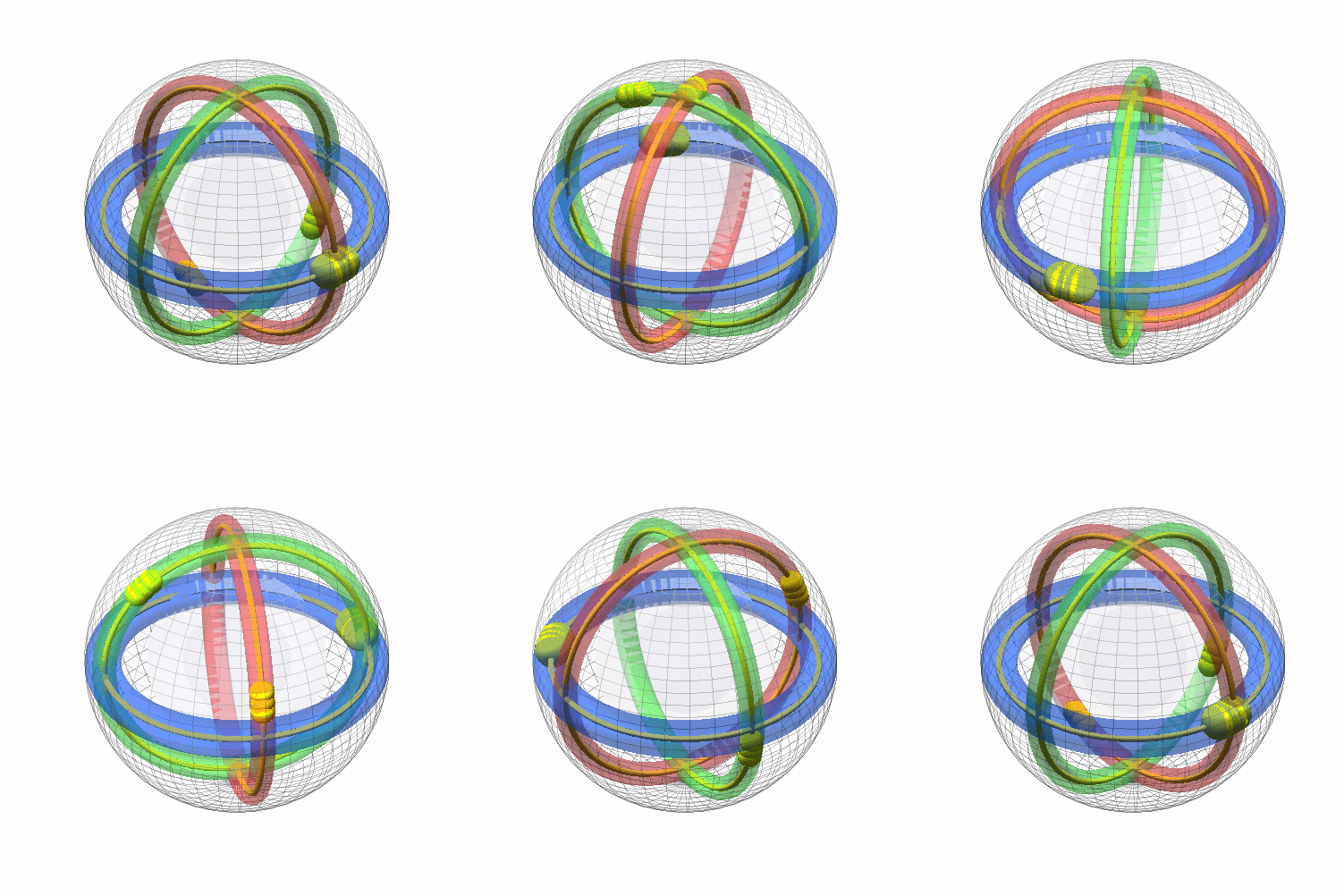
Three confined transport modes inside the nucleon. The 3D model below shows the interior of the nucleon, in which three cylindrical/toroidal transport modes — what conventional physics calls quarks — circulate within the spherical storage core. They are not point particles but confined toroidal transport channels that regulate the core pressure and carry the proton’s spin and magnetic moment. Three are required for stable closure in three dimensions; the framework predicts both the necessity of the three and the geometry of their circulation.
[Figure 2 — 3D quark circulation, animated]
Fusion cross-sections fit without Gamow tunneling. The data points are measured fusion cross-sections from the EXFOR experimental nuclear-reaction database for several light-element channels — D-D, D-T, D-³He, T-³He. Conventional fits use Gamow tunneling through the Coulomb barrier, the standard tool of nuclear astrophysics since 1928. The curves shown here are not Gamow fits — instead they are fit using the framework’s projectile-acceptance model. The theory is based on QWST’s eigenmode-coupling picture, in which fusion is a recoupling event between the internal transport modes of two nucleons. Quantitative agreement with EXFOR data across multiple channels and several orders of magnitude in energy, without invoking barrier tunneling, is a direct empirical test of the coupling-channel framework.
[Figure 3 — fusion cross-sections]
Core Concepts of Quantum Wavespace Theory (QWST)
Two limits force wave behavior. If energy propagates at a maximum speed C and can be stored locally only up to a maximum density P₀, the medium has no choice. Energy that exceeds local storage must redirect into propagation; energy that exceeds propagation must concentrate into local storage. The cycle is forced — wave behavior is not postulated, it is what a doubly-limited medium has to do.
Two stable mode families. Only two geometric configurations persist as eigenmodes of the storage-transport cycle. Spherical storage modes store energy isotropically with a central pressure peak bounded by P₀ falling to a first node at a definite radius r₀ ≈ 6.6 × 10⁻¹⁶ m — these are nucleons. Cylindrical/toroidal transport modes circulate energy along a closed axial path rather than concentrating it at a point. Electrons, photons, neutrinos, and quarks are all members of the transport family, differing in their closure radius and coupling.
The cavity is wavespace. A nucleon at r₀ radiates outward at C and cannot be stable without a coherent return condition at large scale. That condition closes at a global boundary R₀ ≈ 1.3 × 10²⁶ m — the cosmological scale, which matches the observed Hubble distance. The interval between r₀ and R₀ is the cavity in which all stable structure exists. For the cavity to stabilize, the global boundary requires a small but finite leakage of energy.
Three coupling channels exhaust the interactions. With two mode families, three pairwise channels exist: sphere–sphere (gravity, inertia, mass ratios), sphere–cylinder (atomic structure, fine-structure constant), and cylinder–cylinder (radiation, scattering, fusion). Each is quantified by definite geometric integrals. These are the complete interaction basis of the framework. There are no others.
Gravity is what leakage looks like. Infinitesimal leakage at R₀ requires a tiny contraction of each nucleon’s radius r₀. The resulting energy imbalance produces an attractive interaction between any two nucleons in the cavity — exactly what we observe as gravity. Gravity is not a separate force; it is the sphere–sphere coupling channel, quantified by g_Σ — a single number that simultaneously fixes Newton’s G and the hydrogen mass ratio.
Nuclear structure and the quark interpretation. The nucleon’s shells are spaced at 2r₀ node-to-node. Nuclear structure, binding energies, and the internal pressure profile all follow from this geometry. Inside the spherical core, three confined cylindrical/toroidal transport modes circulate — the QWST interpretation of quarks. Three are required for stable closure in three dimensions, and recent 2024 measurements of cylindrical signatures within quarks indicate that this toroidal sub-mode picture is physically correct.
The Lyman series connects atoms to cosmology. Calculation of the hydrogen Lyman series at its limit (n → ∞) recovers the minimum energy density of wavespace, ~10⁻⁴⁵. This same number appears as the gravitational leakage rate, the dark energy density, and the CMB temperature scale. One number, four phenomena across the full range of physics.
The fine-structure constant is derived, not measured. The wave geometry of sphere–cylinder coupling at the Bethe aperture factorizes as α⁻¹ = B₀ × β₀, where B₀ is the geometric mode overlap and β₀ is the aperture return correction. The leading-order calculation gives α⁻¹ ≈ 135.4. The higher-order Fabry-Pérot return series — natural to the coupling geometry — brings the value to the full CODATA precision of 137.036. The same geometry recovers the electron magnetic anomaly. This is a falsifiable prediction: compute the Bessel overlap integral independently, and the framework either reproduces both constants or it fails.
The framework hasn’t broken yet. We have tested it against CODATA values for α, R∞, G, the Bohr radius, the electron mass, the magnetic anomaly, the proton-electron mass ratio, the CMB temperature, the perihelion precessions of Mercury, Venus, and Earth, and the MOND acceleration floor. From two inputs — C and P₀ — the framework spans more than seventy orders of magnitude. We keep expecting it to fail. It hasn’t.
Why Wavespace Theory Is Worth Examining
QWST is a wave-substrate theory whose novelty lies in a specific combination of three structural ingredients. Each has antecedents in the literature; the combination does not.
The saturation postulate P₀. A bounded local energy-storage density complements the bounded propagation speed C. The wave-based programs of the 1920s — de Broglie’s matter waves, Schrödinger’s wave mechanics, the ether theories preceding them — failed because amplitudes were unbounded and localized solutions dispersed. P₀ closes that loophole: amplitudes saturate at a definite ceiling, standing waves clip to a definite radius r₀, stable particles exist as eigenmodes of the storage-transport cycle. The value P₀ ≈ 5×10³⁵ Pa was predicted by H.W. Schmitz in the 1970s and matches the DVCS measurement of proton internal pressure (Burkert, Elouadrhiri, Girod, Nature 2018) at the same scale.
The two-mode geometric restriction. The eigenmodes of the storage-transport cycle are exhausted by two geometries: spherical storage (the nucleon family) and cylindrical/toroidal transport (electron, photon, neutrino, quark). No third stable family exists. This restriction is unusual — de Broglie, Bohm, and stochastic electrodynamics all leave the mode space underdetermined. The QWST restriction turns geometry into a predictive constraint and reduces the parameter space of the theory to a small set of definite geometric integrals.
Cross-scale coupling via g_Σ. The local boundary at r₀ and the global boundary at R₀ are coupled through a single dimensionless number g_Σ that simultaneously fixes Newton’s G and the proton-electron mass ratio. Verlinde (2011, 2017) recovered a MOND-like acceleration scale a₀ = cH₀ from holographic information; the QWST version is wave-mechanical rather than entropic and additionally fixes atomic-scale relations Verlinde does not address. Sciama (1953) proposed Machian inertia from global coupling but did not produce a quantitative framework.
Headline relations and closure chain. m_n C² = A₀ P₀ r₀³ (nucleon mass from storage) h = 2 m_n r₀ C (Planck constant as storage–transport conversion) λ_p = 2 r₀ (Compton wavelength as nucleon node spacing) α⁻¹ = B₀ β₀ ≈ 137.036 (fine structure from sphere–cylinder coupling) m_p/m_e = (6 g_Σ α)² (mass ratio from sphere–sphere coupling) R_∞ = 1/(144 g_Σ² r₀) (Rydberg from coherent shell reach) δr₀/r₀ = r₀/(2 R₀ g_Σ) (gravitational leakage scale) R₀ ≈ D_H (cosmological boundary as Hubble distance)
Empirical agreement spans seventy orders of magnitude. From C, P₀, and a small set of definite geometric integrals (A₀, B₀, β₀) plus one calibration constant (g_Σ, fixed from R_∞), the framework recovers CODATA values for α, R∞, G, the Bohr radius, the electron mass, the electron magnetic anomaly, the proton-electron mass ratio, the CMB temperature, the perihelion precessions of Mercury, Venus, and Earth, and the MOND acceleration floor in galactic rotation curves. No other free parameters enter.
Falsifiable predictions. The framework predicts (i) the coherence correction ℓ^(d) ≈ 0.976 evaluable as a definite Bessel overlap integral, independent of the measured α; (ii) two independent derivations of the leakage scale δr₀/r₀ = r₀/(2 R₀ g_Σ), which must agree at higher precision; (iii) a photon polarization threshold at E ≈ 4 GeV where the photon’s local energy density reaches P₀; (iv) the Lyman-series convergence at T_CMB without cosmological input. Any of these failing at experimental precision would invalidate the framework.
Position relative to prior work. The wave-substrate program has multiple antecedents: de Broglie’s matter waves (1924), Bohm’s pilot wave (1952), Sciama’s Machian inertia (1953), Sakharov’s induced gravity (1968), stochastic electrodynamics (Boyer and colleagues, 1970s), acoustic analog gravity (Unruh 1981, Visser 1998), Verlinde’s emergent gravity (2011, 2017), and the hydrodynamic pilot-wave program of Couder, Fort, and Bush (2005–present), which demonstrates wave-piloted self-propulsion of localized structures at the tabletop scale. QWST is most accurately positioned as the next step in this lineage: a wave-substrate theory with the saturation principle the earlier programs lacked, the geometric restriction the empirical programs demonstrate but do not theorize, and the cross-scale coupling no antecedent quantified.
Current weakness. The higher-order corrections to α and the electron magnetic anomaly require numerical evaluation of three-dimensional Bessel overlap integrals at the aperture boundary. This is identified as a concrete next step rather than a gap in the foundation.
We invite physicists to scrutinize these findings. The foundational document and companion papers are linked below..
What Quantum Wavespace Theory Is Not
QWST is not an alternative to the Standard Model, quantum mechanics, special relativity, or general relativity. It does not compete with established physical theories — it explains why they work. QWST provides a deeper, more primitive foundation from which these theories emerge as effective limits. Their mathematical form and empirical success are preserved; their origin is traced to underlying wave and boundary dynamics. The Dirac equation, Maxwell’s equations, and the Einstein field equations are unmodified within their established domains of validity.
QWST is not a “theory of everything” in the speculative sense. It does not propose to replace the Standard Model with a single new equation or to unify all four forces through a new gauge symmetry. It identifies two physical limits — a maximum propagation speed C and a maximum local energy-storage density P₀ — from which the constants of nature and the structures of nuclear, atomic, gravitational, and cosmological physics are recoverable. It is a foundational framework, not a TOE candidate.
QWST is not a quantum interpretation. It is not Copenhagen, many-worlds, transactional, consistent histories, QBism, or relational quantum mechanics. It does not propose a new reading of the wave function, a new measurement rule, or a new ontology of observation. It is an underlying substrate theory from which quantum mechanics emerges in the appropriate limit. The interpretation question of standard quantum mechanics is, in this picture, a question about what the substrate is doing.
QWST is not pilot-wave or Bohmian mechanics. It shares with de Broglie (1924) and Bohm (1952) the position that the wave function corresponds to a physical wave structure, but it adds a saturation limit P₀ that neither de Broglie nor Bohm proposed. The saturation limit is what allows stable localized particles to exist as eigenmodes of the substrate, resolving the central failure of the original wave-realist programs. QWST is closer in spirit to the hydrodynamic pilot-wave program of Couder, Fort, and Bush (2005–present) than to Bohmian mechanics, but is a full theoretical framework rather than a tabletop analog.
QWST is not modified gravity or MOND. It recovers Newton’s gravitational constant G, the perihelion precessions of Mercury, Venus, and Earth, and the weak-field results of general relativity without modifying Einstein’s field equations in their established domain. It also recovers the MOND acceleration scale a₀ ≈ 1.2 × 10⁻¹⁰ m/s² as a direct geometric consequence of the cavity boundary R₀, without invoking dark matter and without modifying Newtonian dynamics. The MOND scale is a prediction, not a postulate.
QWST does not introduce complexity – it is a closed system defined by C and P0. It introduces no hidden variables, no extra dimensions, no new forces, no speculative particles, and no preferred reference frame. The entire framework is closed under the two physical limits C and P₀. The Dirac equation, Maxwell’s equations, and the Einstein field equations are preserved.
QWST is not an aether or recycled wave theory. The aether of the nineteenth century was a mechanical medium defining a preferred reference frame, ruled out by the Michelson–Morley experiment in 1887 and by Einstein’s special relativity in 1905. The QWST wavespace is Lorentz-invariant and supports only specific stable eigenmodes — geometric configurations of the medium, not flow through a preferred substance. The new ingredient is the saturation principle P₀, which neither the aether theories nor the wave-mechanical theories that succeeded them included.
QWST is not numerology. Its derived relations were not obtained by fitting constants to data. They arise from a physical model constrained by energy saturation, wave stability, and Lorentz invariance. Agreement with measured constants — across more than seventy orders of magnitude in scale — was discovered after the framework was established, not imposed beforehand. The framework’s central pressure scale, P₀ ≈ 5 × 10³⁵ Pa, was proposed decades before the Burkert–Elouadrhiri–Girod pressure extraction, and is numerically consistent with the pressure scale inferred from that analysis.
QWST is not string theory, loop quantum gravity, or a competing program in fundamental physics. It does not propose extra spatial dimensions, quantized spacetime, supersymmetric particles, or new gauge symmetries. It operates within ordinary 3+1 dimensional spacetime with one additional physical constant (P₀) and recovers the established results of quantum mechanics and general relativity as limits.
QWST is not merely speculative. It is mathematically explicit, makes quantitative predictions with stated numerical residuals, satisfies Lorentz invariance and relativistic causality, and identifies specific falsifiable tests by which it could be invalidated. Its central numerical prediction was made in the 1970s by H. W. Schmitz decades before the first experimental extraction of the proton’s internal pressure distribution and agrees in order of magnitude with the Burkert–Elouadrhiri–Girod result.. The framework has been developed across multiple documents and continues as an active research program.
QWST is not packaging existing physics in a new mathematical language.
QWST is not an interpretation layered on top of existing formalisms, nor a reformulation of quantum mechanics in different mathematical language. It does not posit an ether, preferred reference frame, or violation of Lorentz invariance.
How QWST Differs from Standard Quantum Theory
No Fundamental Particles or Fields
QWST does not assume particles, fields, or gauge symmetries as primitives. These emerge from wave geometry and saturation constraints.
Wave–Particle Duality Resolved
Wave and particle behavior are unified: localized particles are standing waves whose coherence and boundary structure determine observable behavior.
Gravity as Boundary Leakage
Weak gravitational effects arise from slow energy leakage through saturated boundaries, producing an effective refractive structure consistent with general relativity in the weak-field limit.
Unified Geometric Framework
Quantum mechanics, electromagnetism, and gravity emerge from a single constrained wave substrate, without quantization rules or renormalization as fundamental inputs.
Predictions & Potential Tests
- Reproduces the fine-structure constant and electron magnetic anomaly without perturbative renormalization.
- Predicts specific saturation-driven particle structures and boundary geometries.
- Suggests experimentally testable deviations when wave saturation or boundary closure fails at high excitation.
Status
Quantum Wavespace Theory is a mathematically explicit, wave-based framework that reproduces key empirical results of quantum electrodynamics and gravitation while offering a deeper geometric explanation of their origin. Quantum Wavespace Theory is an active independent research program developed through public reference manuscripts, preprints, and companion analyses. These materials are intended as a transparent technical record. Readers are invited to examine the derivations, identify errors, suggest corrections, or test individual closure relations independently.
QUANTUM WAVESPACE THEORY 2024 – DETAILED DOCUMENT(QWST)
Harry W. Schmitz (1924-1979) derived the limiting pressure of a nucleon core in the 1970s as a direct consequence of his theoretical standing-wave framework:
P₀ = ~10³⁵ Pa
Nearly forty years later, the first experimental extraction of the proton’s internal pressure distribution by Burkert, Elouadrhiri, and Girod (2018) reported a central pressure of order 10³⁵ Pa, the highest known in the universe. Before publication in 2018, no experimental value was available.
Their analysis also located a zero-pressure node defining the proton’s effective radius, distinct from earlier RMS charge-radius estimates. They reported the internal pressure changes sign from repulsive to binding at approximately 0.6 fm, matching the zero-pressure node r₀ predicted by H. W. Schmitz.
r₀ = 6.607 × 10⁻¹⁶ m
Although derived independently from C and P₀, this value satisfies the relation 2r₀ = λ_p, where λ_p = h/(m_p c) is the proton’s Compton wavelength. The identity is not imposed — it emerges from the geometry. In QWST, the Compton wavelength therefore has a direct structural meaning as the node-to-node spacing of the spherical storage mode rather than as an abstract quantum-mechanical scale.
Both the central pressure and the node to node radius coincide with the values calculated by H. W. Schmitz in the 1970s. This constitutes a rare case where a quantitative prediction, made decades before experiment, was later confirmed at the same scale. The precision of these predictions provides a benchmark for future measurements: as empirical constraints on pressure distributions and spatial scales improve, they will further test the theory’s predictive framework. The agreement underscores the predictive and falsifiable nature of the QWST postulates. His work was later published as The Physical and Philosophical Nature of the Universe By H. W. Schmitz and H. A. Schmitz, Library of Congress Copyright: 83 – 70164. Quantum Wavespace theory is based on this work.

