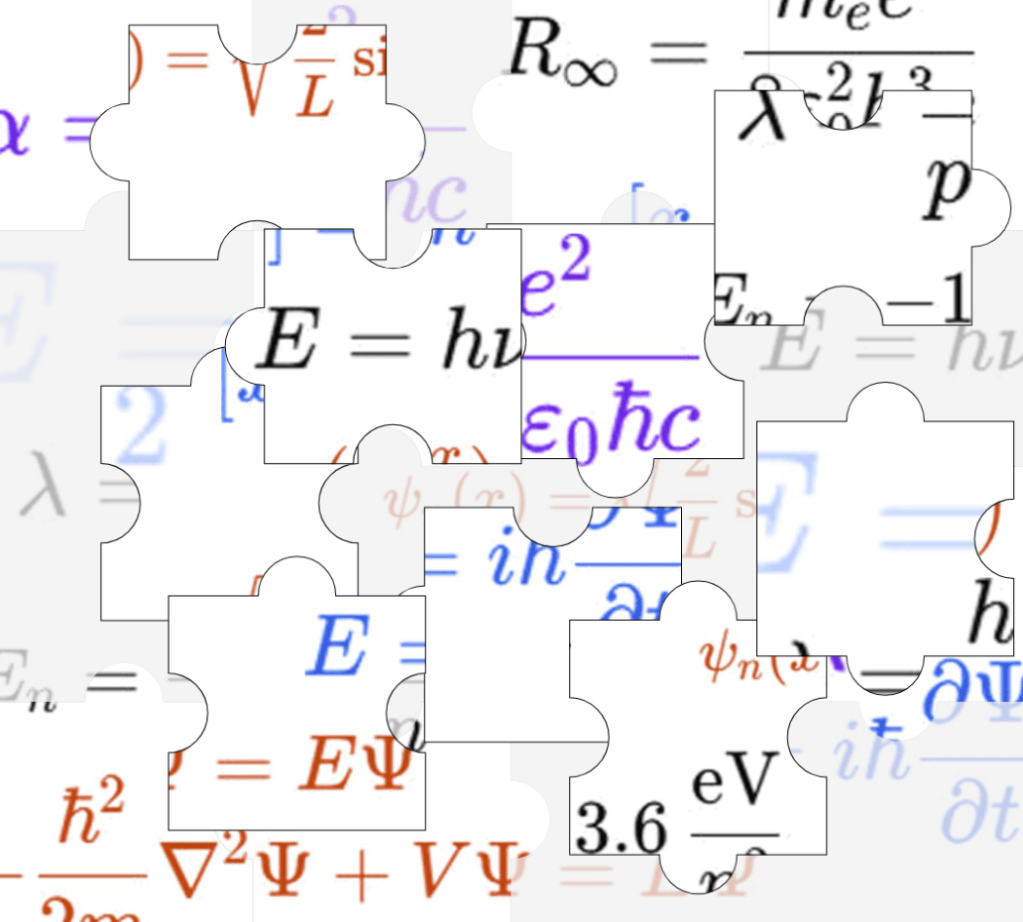
Quantum Mechanics: An Incomplete Puzzle
While Quantum Mechanics stands as one of the greatest intellectual triumphs in human history it remains stubbornly immune to revealing its inner secrets. Constructed from abstract mathematical frameworks—wavefunctions, probability amplitudes, and an “uncertainty principle”—quantum mechanics is conceptually fragmented. Although it provides us with extraordinarily accurate predictions, familiar questions are left unanswered:
- Why does measurement seemingly cause wavefunctions to collapse?
- What is the physical basis for quantization of energy levels in atoms?
- What explains the wavefunction and its probability interpretation?
- Why do fundamental physical constants have their specific measured values?
- How does wave-particle duality arise?
- What explains quantum entanglement and instantaneous correlations at distance?
- What is the physical explanation for the uncertainty principle?
- How is quantum superposition explained?
These gaps have suggested to physicists that quantum mechanics is part of a more fundamental structure—a large puzzle still missing crucial pieces.
 Quantum Wavespace Theory
Leave a comment